



Revolutionizing Education with AI-Powered Personalized Learning Platforms in 2026

Revolutionizing Education with AI-Powered Personalized Learning Platforms in 2025
66views
In the fast-paced of 2026, education finds itself at a turning point. Classrooms with rows of desks and chalkboards playing home to lessons that never quite fit are quickly being replaced by intelligent adaptive systems designed to place the student at the center. AI-powered personalized learning platforms lead this transformation by allowing adjustment of content, pace, and delivery mode to suit each learner’s requirements, readiness levels, and preferred style of learning. These tools leverage artificial intelligence-based analyses on data for predicting hurdles and mapping individualized roadmaps toward success.
Imagine a student not getting it right with math: instead of repeating the same lesson for everybody, in real-time, add small explanations or simulations that might probably be games. This is not only a trend but also a shift of need. Companies put big money in as the global market of AI education lifts to $7.57 billion this year with fast steady growth. It makes learning fun from K-12 and higher education, and better than before.
This paper will take a critical look at the transformation that AI brings into education by delving deep into some of the major technologies comprising Gemini AI Tutoring, VR/AR Immersive Courses, Generative AI Microlearning, and NotebookLM Study Tools. These innovations are driving tomorrow’s classroom and learning environment to an experience much deeper than what exists today with better results. By the end of this paper, you will agree that by 2026, real individualized education will have been born.
The Growth of Customized Learning
Personalized learning was coined as a buzzword but has since dropped that superficial tag to be an essential part of today’s real education. By the year 2026, more than 57 percent of all higher education institutions prioritize AI implementations toward the delivery of custom experiences. These platforms are way advanced from existing simple online courses; there is a thorough progress-tracking mechanism wherein weaknesses are identified and then brought to the notice so that they can be worked upon.
Understanding Personalized Learning
Personalized learning at the heart of it means education that suits or fits the individual. It takes into consideration factors such as pace of learning, interest, and even cultural background. AI will do this through massive data input from quizzes, interactions, and feedback used in processing. For example, adaptive systems may change visual aids to hands-on activities if the student responds better with the latter.
The method raised retention and motivation. In the personalized environment, learners have up to a 30% increment in major subjects. The launch of an AI Centre of Excellence in India is just one among several efforts driving large scale adoption, propelled by government budgets that have set aside amounts to support such personalized tools. On a global scale, platforms house AI that builds dynamic curricula.
Going forward, through the cloud-based solutions, these systems are reaching even the remotest areas where education is being uplifted. The outcome would be a natural education that empowers learners to understand effectively a technology-driven world.
Key AI Technologies Driving Change
The real strength of artificial intelligence shines in specific tools that make learning both engaging and effective. Four great innovations stand at the front in 2026: Gemini AI Tutoring, VR/AR Immersive Courses, Generative AI Microlearning, and NotebookLM Study Tools. They come at different angles of education from personal support to deep discovery.
Gemini AI Tutoring: Your Virtual Guide
Gemini AI Tutoring by Google is perceived as a major breakthrough in offering personalized assistance. It acts like a human tutor always at one’s disposal, parsing different inputs provided by learners’ uploaded assignments and essay drafts to give highly detailed feedback instantaneously. This classroom feature got teachers smiling all the way because it saves their time whereby they have to create practice quizzes and lessons adjusted to the needs of the class.
Guided learning functions essentially like a human tutor, offering steps just as a human tutor might. For example, should a learner pose an inquiry related to physics and take a picture of the corresponding problem, Gemini AI Tutoring will decompose it with easy explanations and hints. Schools denote elevated engagement by 2026 from scholars applying it for all things from language practice to intricate coding.
Gemini AI Tutoring is set apart by its use with everyday tools like Google Classroom. It creates individual study plans, monitors progress and even gives resources based on real-time outcomes. In one global rollout more than 70% of users got better grades showing its impact on all types of learners. As usage increases Gemini AI Tutoring is turning into a routine ensuring that every student gets expert help at no added cost.
VR/AR Immersive Courses: Bringing Lessons to Life
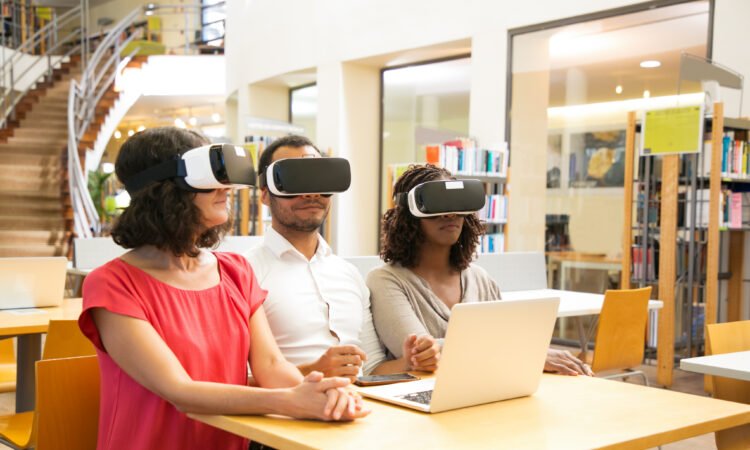
IMSIM nxt (Immersive Simulation Next) is an immersive simulation using AR/VR that takes learners beyond the traditional learning experience by bringing them into worlds where they can physically interact with their lessons. Virtual Reality creates whole environments, while Augmented reality displays digital elements in the real world as it is seen through a device (e.g., doing a frog dissection on a tablet).
In 2026, they will get large schools. Leading programs such as those at Georgia Tech make use of VR/AR Immersive Courses for teaching STEM with a 75% better retention rate. Students do not sit and read about history. They get up and walk it, learning more about being her.
For young kids, VR/AR Immersive Courses mean the realization of unattainable concepts. Picture lessons in biology where children put together DNA models inside a three-dimensional space. Events such as Conferences in 2026 on Immersive Learning show how tools combine with AI to generate adaptive situations – if the student is having difficulties, the simulation will slow down or accelerate with more/fewer helpers.
Low-cost headsets and mobile AR apps are here to help solve the device challenges. The solution has already made it to over 25 public schools in the U.S., ready to scale all around the world. They turn passive learning into active quests, creators who build futures for learners.
Generative AI Microlearning: Bite-Sized Genius
Generative AI Microlearning delivers content in short, focused bursts of time-about 3 to 5 minutes at a time-on-demand. Content creation is based on the goals of the users and comes in the form of quizzes or videos. It fits perfectly into even the busiest of schedules. Companies like Axonify have led with Generative AI Microlearning, enabling whole modules to be created from simple prompts. This has led to a 40% higher completion rate when applied both at corporate training and schools because learners return for quick wins.
The Generative AI Microlearning comes with the importance of being adaptive. If one learner gets bogged down by decimals after getting fractions right, drills of a specific nature will be created content by AI. For instance, it is to be used by Duolingo in their 2026 updates over 148 paths to learning different languages gamification merged with personalization.
Trainers insert Generative AI Microlearning into their day’s work, be it in the morning review or refresher of a skill. It is most important for lifelong learning since it allows adults to upskill without any cognitive dissonance. As tools are changing, Generative AI Microlearning makes education agile and playful like contemporary life.
NotebookLM Study Tools: Organizing Knowledge Smartly
NotebookLM Study Tools turn chaos into clarity. Throw the notes in, get back interactive study aids. Google’s most brilliant AI NotebookLM spits out podcasts from your textbooks, flashcards, and full study guides-all within minutes.
By 2026, it will go viral for test prep. Throw NotebookLM Study Tools a pile of unstructured lecture notes, and it builds a “learning guide” tutor that quizzes you in normal conversation, which is exactly like what you have to face at the test. Teachers throw some material to build visual timelines or audio overviews. Actual hours, saved.
It lies in accuracy- every output comes with sources thereby minimizing errors. For group study, NotebookLM Study Tools even enhance collaboration. Recent updates now allow it to work hand-in-hand with Gemini making a total ecosystem for research and review.
From high school essays to college theses, the NotebookLM Study Tools nurture the growth of independent learning. It becomes easy to see why educators have referred to this product as a ‘game-changer’ for 2026 because of AI flashcards and so many more features! The truth is that NotebookLM Study Tools democratizes study success one smart summary at a time.
Benefits of AI-Powered Platforms
- Uptake: VR/AR Immersive Courses and Gen AI microlearning experiences support stick, reducing attrition by as much as 25%.
- Output: Gemini AI Tutoring and NotebookLM Study Tools individualize paths. Average uplift-30% better scores.
- Always On: Cloud-based systems for remote kids fill the city-country gap-already seen in global MOOC expansions.
- Teacher Time: AI does the drudge, humans do the mentoring – 57% of institutions report time saved.
- Lifelong Skills: They nurture critical thinking and flexibility, factors for the future of work.
- Growth at Low Cost: Free of charge or at low cost – for example, the Gemini AI Tutoring Platform – able to propagate higher learning.
Such advantages result in equitable, effective teaching environments.
Barriers and Remedies
Though it appears auspicious, implementing AI has to surmount a number of hurdles. The table beneath just lists a few prevalent issues with practical remedies:
| Challenge | Description | Solution |
| Privacy policies | because handling student data can be very sensitive. | Use encrypted platforms only, and make sure that the platform is compliant with such laws as GDPR or any local version of it plus best practices from staff training. |
| Not all have devices and an internet connection. | Partner with governments in the necessary subsidies; use in offline mode some tools made user-friendly for Generative AI Microlearning to work without a device. | |
| Teacher-Training gaps | since more skills are required among educators to integrate AI effectively. | Run free courses online like Google’s Generative AI Microlearning for Educators program. |
| Accessibility will be determined by biases in access | since such advanced features as VR/AR Immersive Courses are quite pricey on the market today. | Start with mobile AR; apply grants to schools similar to that seen in the Hong Kong 2026 plan. |
Their address ensures smooth implementation.
Future Outlook
From 2026 onwards, AI will be further fused in. In prospect are Hybrid models where Gemini AI Tutoring teams up with VR/AR Immersive Courses for joined-up experiences. Gen AI Generative AI Microlearning morphs into predictive coaching while NotebookLM Study Tools ramp up to collaborative global classrooms. Just as India’s push of ₹500 crore investment, personalized education becomes the normal inspiring innovation across geographies.
Conclusion
AI-driven individual learning systems progressively play a significant role in the education area. By 2026, such systems would deliver a joint and efficient training cycle coming about because of Gemini AI Tutoring‘s direction up to the miracle achieved by Immersive Courses of VR/AR Immersive Courses. Basically, it implies enabling each student with a tool accessible to us if utilized appropriately. All things considered, the eventual fate of schooling is more splendidly prepared and drawn in with vast conceivable outcomes.
For more exclusive Education updates, visit Reminder Magazine
add a comment